
A neutral monetary policy stance, heavy government borrowing, and issuers adjusting to a higher-for-longer yield environment have set the stage for a largely stable corporate bond market in 2026.
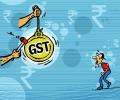
India needs Goods and Services Tax (GST) Council-like common platforms between states and the Centre in areas such as land clearances, power, and water to fast-track infrastructure projects to achieve double-digit growth going ahead, said Praveer Sinha, chief executive officer and managing director of The Tata Power Company.

India Ratings & Research (Ind-Ra) has projected the aggregate fiscal deficit of states to rise to 3 per cent of gross domestic product (GDP) in 2026-27 (FY27), from an estimated 2.8 per cent in 2025-26 (FY26), citing higher revenue expenditure amid election-related pressures and scheme cost-sharing requirements.

The business value of the league, popularly called the IPL, surged to a record $18.5 billion last year, U.S.-based investment bank Houlihan Lokey says.

Finance Minister Nirmala Sitharaman announces increased domestic LPG production to offset import disruptions caused by Middle East tensions, alongside assurances of fertiliser availability and the clearing of UPA-era oil bonds.

India's household debt climbed to 41.3 per cent of gross domestic product (GDP) at the end of March 2025, marking a sustained rise from its five-year average of 38.3 per cent, with consumption-related loans accounting for bulk of the borrowings, the Reserve Bank of India (RBI) said in its Financial Stability Report.

Platform-style partnerships between global investors and Indian developers are expected to gain further traction over the next few years. This comes as institutional capital increasingly shifts from one-off asset acquisitions to scalable, long-term strategies.

Trading pattern in the stock market this week will largely depend on the ongoing Q3 earnings announcement from corporates, global trends, and foreign fund movement, analysts said. Moreover, geopolitical developments and any update on trade negotiations would also be keenly tracked by investors, experts noted.

Eternal was the biggest gainer in the Sensex pack, jumping 4.50 per cent, followed by Power Grid, ICICI Bank, Reliance Industries, UltraTech Cement, Adani Ports, Sun Pharma, ITC and Hindustan Unilever were also among the winners. In contrast, IndusInd Bank, Axis Bank, Bajaj Finserv and Bajaj Finance were among the laggards.

From the 30-Sensex firms, Larsen & Toubro, Tech Mahindra, Tata Consultancy Services, Reliance Industries, Tata Steel, and Trent were among the biggest laggards. On the other hand, Eternal, ICICI Bank, Bajaj Finance, and Bharat Electronics were the gainers.

Qatar's sovereign wealth fund is in early discussions to buy a minority stake in billionaire Mukesh Ambani's rapidly expanding retail unit for about $1 billion (Rs 8,200 crore), sources said. The Qatar Investment Authority is keen on tapping the fast-growing Indian market and has entered into a discussion to buy about 1 per cent stake in Reliance Retail Ventures, sources with knowledge of the matter said. Talks, sources said, are at a preliminary stage and being led by an executive director on the board of parent Reliance Industries Ltd.

'The first time India has seen two consecutive blockbuster IPO years.'

Ask rediffGURU Reetika Sharma your insurance, mutual fund and personal finance-related questions.

From the Sensex pack, Asian Paints, UltraTech Cement, Power Grid, ICICI Bank, Reliance Industries, Hindustan Unilever, Bharat Electronics and Sun Pharma were among the major gainers. In contrast, Trent, Eternal, Axis Bank and Titan were among the laggards.

The Indian rupee, swaying through multiple headwinds, tiding over global trade disruptions and massive foreign fund outlfows, is unlikely to arrest its descent until tariff impact overhangs, notwithstanding robust domestic macroeconomic tailwinds. The Reserve Bank of India (RBI), which sees the rupee's depreciation as a silver bullet to offset the tariff shock, expects the currency to find its stable course once India reaches a trade deal with its largest trading partner, the US.

There is positive sentiment for Tata Steel on the basis of strong domestic demand, a turnaround of European operations and moderate valuations. A combination of capacity expansion, efficiency gains, higher asset utilisation, and improved operating leverage may lead to margin expansions.

Noting that recent uncertainties created by global tariffs have not impacted the Indian economy severely, Anuradha Thakur, secretary, Department of Economic Affairs, said the central government is hopeful that the recent goods and services tax (GST) rationalisation will ignite the much needed animal spirits in the financial sector.
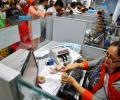
With deposit growth remaining sluggish and the credit - deposit ratio of commercial banks crossing 80 per cent, banks have ramped up their borrowing in the certificate of deposit (CD) market. In the fortnight ended November 14, CD issuances climbed to nearly Rs 55,000 crore - double the borrowings of the preceding two fortnights and the highest since the September 19 fortnight.

'Only four or five original companies remain; the rest have been replaced every decade as sectors evolve or leadership shifts.' 'Companies that fail to adapt -- like many textile mills from the 1970s and shipping firms from the 1980s -- disappear.' 'Benchmark indices reward those who reinvent themselves in line with economic demands.'


India's $280-billion IT industry heads into 2026, balancing visa-related headwinds and global trade uncertainty against its biggest-ever push into artificial intelligence and the rapid expansion of global capability centres (GCCs). Heightened scrutiny of the US H-1B visa programme - including a proposed $100,000 fee for new visas and concerns over a potential 25 per cent outsourcing tax - has complicated cross-border delivery for Indian firms, even as companies accelerate efforts to reduce reliance on onsite staffing.

Usually, in the western view, corporate success is attributed to efficiency, organisational structure, and scale. R Gopalakrishnan and Harish Bhat argue that philosophy, culture, and the transmission of values are more important for sustaining growth and profitability of an enterprise over a period of time.

From the 30-share blue-chip pack, Adani Ports, UltraTech Cement, Larsen & Toubro, Sun Pharma, HDFC Bank, ICICI Bank, NTPC and State Bank of India were the major laggards. Tata Consultancy Services, Reliance Industries, ITC, Asian Paints, HCL Tech and Maruti were among the gainers.

Qatar Investment Authority (QIA) will acquire around 1 per cent stake in Reliance Retail Ventures Ltd (RRVL), the retail arm of billionaire Mukesh Ambani-led Reliance Industries, by investing Rs 8,278 crore ($1 billion). A QIA's wholly-owned subsidiary will make the investment in India's largest retailer at a valuation of Rs 8.278 lakh crore ($100 billion). Updating about the development, Reliance Industries in a regulatory filing said: "QIA's investment will translate into a minority equity stake of 0.99 per cent in RRVL on a fully-diluted basis." RRVL is the holding company for all retail businesses of Reliance Industries Ltd (RIL).

From the Sensex firms, Reliance Industries, Tech Mahindra, Eternal, HCL Tech, Infosys, IndusInd Bank, Tata Consultancy Services and Bajaj Finserv were the biggest gainers. In contrast, UltraTech Cement, Sun Pharma, Power Grid, NTPC, Kotak Mahindra Bank and Mahindra & Mahindra were among the laggards.
Among Sensex firms, Bharti Airtel, Reliance Industries, Eternal, State Bank of India, Tata Steel and HDFC Bank were the major gainers. However, Kotak Mahindra Bank, Bharat Electronics, Infosys and Bajaj Finance were among the laggards.

The stock of Bharti Airtel, India's largest listed telecommunications (telecom) services provider, recently hit an all-time high on expectations of higher average revenue per user (Arpu), a stable market setup, and fresh revenue lines.

Benchmark indices Sensex and Nifty closed lower in a highly volatile trade on Thursday amid relentless foreign fund outflows and selling in blue-chip ICICI Bank. Falling for the second day in a row, the 30-share BSE Sensex declined 148.14 points or 0.18 per cent to settle at 83,311.01.

The domestic initial public offering (IPO) market is experiencing a significant surge, fuelled by the financialisation of savings, digital ease of investing, and expanding participation from both retail and institutional investors, investment bankers said on Wednesday.

Dalal Street is buzzing with excitement, as some of the most-awaited IPOs are gearing up to hit the market. While some of these big companies are planning to join the stock exchanges towards the end of 2025, others are likely to be available for trading by the first half of 2026.

Microsoft CEO Satya Nadella on Tuesday announced plans to invest $17.5 billion in India to help build infrastructure and sovereign capabilities for the country's AI-first future, marking the third major AI-driven investment in the country in the past two months. Microsoft said that the $17.5 billion (around Rs 1.58 lakh crore) investment builds on the $3 billion (around Rs 26,955 crore) funding announced earlier this year, which the company is on track to spend by the end of CY (calendar year) 2026.

'Equities may not outperform every year, but if they do so seven times out of 10, it's an asset class worth relying on.'

With average returns of 18 per cent over the past year, listed real estate investment trusts (Reits) have clearly outperformed both the Nifty Realty index and the Sensex. Over the same period, Nifty Realty fell 15.5 per cent, while the benchmark index was largely unchanged. Steady office leasing, the Securities and Exchange Board of India's (Sebi's) decision to reclassify Reits as equity instruments, and ongoing portfolio expansion have strengthened the sector's appeal.

From the Sensex pack, Bajaj Finserv, Larsen & Toubro, Bajaj Finance, HDFC Bank, Bharat Electronics and Kotak Mahindra Bank were among the major laggards. However, Tata Steel, Asian Paints, UltraTech Cement, and Trent were the biggest gainers.

Bank credit growth is expected to moderate this financial year after a robust 16 per cent estimated for last financial year, driven by strong economic activity and retail credit demand. There are three reasons for this: a statistical high-base effect given the strong growth seen last financial year, revision in risk weights by the Reserve Bank of India (RBI), and relatively slower economic activity.

After record fund raising, Reliance Industries now has a strong balance sheet with high liquidity that will support growth plans for its three hyper-growth engines, Jio, Retail and oil-to-chemicals, according to the firm's chairman and managing director Mukesh Ambani. In the company's latest annual report released on Wednesday, he said the company sold minority stakes in Jio Platforms -- the unit that houses its telecom and digital business -- and retail arm for almost Rs 2 lakh crore and raised another Rs 53,124 crore through rights issue.

Reliance Jio, India's biggest telecom operator, is planning to launch an initial public offering (IPO) and listing on bourses in the first half of 2026, billionaire Mukesh Ambani said on Friday. Jio is currently a unit of Reliance Industries Ltd, India's most valuable company.

'Such stocks may be useful for aggressive portfolios, but should not be part of the core holdings.'

'Our problem is not a budget deficit but a trust deficit. We need to trust our institutions and industries to innovate and lead. That is the way forward for India.'
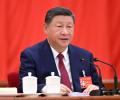
If Xi Jinping is dethroned in the future, the instrument for that may well be embedded within the PLA, notes former foreign secretary Shyam Saran.
